The wave pattern on the 4-hour chart for EUR/USD has changed. There is still no indication of the cancellation of the upward trend segment that began in January last year; however, the wave structure of the trend now looks very ambiguous. In such situations, I always recommend switching to a lower timeframe and focusing on the simplest and smallest wave structures.
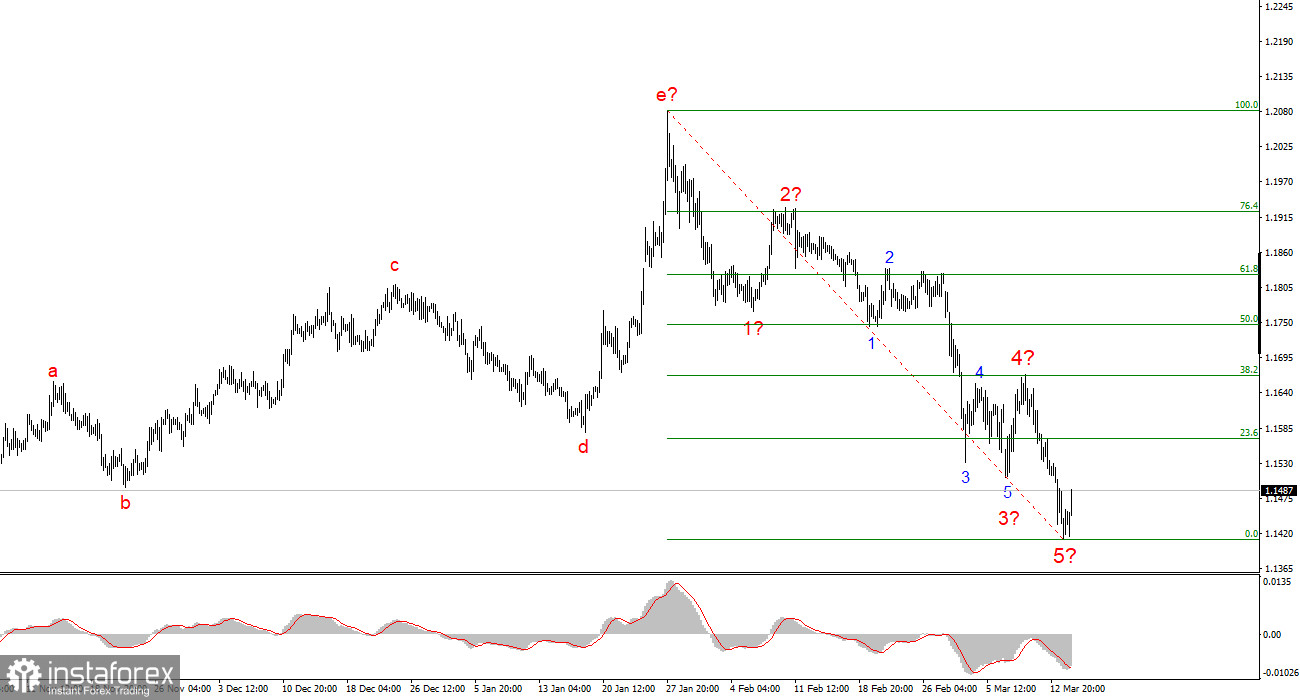
In the chart above, I can identify a classic five-wave impulse structure with an extension in the third wave. If this is indeed the case, then the formation of this structure has been completed, and we should expect a corrective structure consisting of at least three waves. Therefore, in the near term, an increase in the pair's quotes can be expected, but only within a correction relative to the latest trend segment. For now, the latest wave structures fit very poorly into the higher-degree wave count, but the situation should become clearer over time. In the near future, the European currency may recover toward the levels of 1.1568 and 1.1666.
The EUR/USD pair rose by 70 basis points on Monday, which was somewhat unexpected. Of course, corrective waves must occur in any trend, but in recent weeks we have almost become unaccustomed to such a phenomenon as a decline in the dollar. Nevertheless, although the wave structure has changed, corrective waves must still occur. Therefore, further strengthening of the European currency can be expected even without taking the news background into account.
The news background this week will be very complex for both the euro and the dollar. In Europe, the ECB will hold a meeting during which Christine Lagarde will have to explain to the markets how negative the inflation forecasts for 2026 are. Let me remind you that the energy crisis will hit the European Union hard, and rising oil and gas prices will inevitably lead to higher prices for almost all goods and services. The question is what measures the European regulator will be ready to take in order to prevent a new uncontrolled surge in prices. If the Consumer Price Index begins to accelerate again, there may be only one solution — raising interest rates. Is the ECB ready for such a step given the weak growth of the European economy and the potential for even greater slowdown? Christine Lagarde will have to answer this question.
The Fed will also hold a meeting this week, and the number of issues on the agenda will be much greater than in Europe. Recent reports on the U.S. labor market have shown a complete absence of easing, while inflation, as already mentioned, may accelerate significantly in 2026. Which of these indicators is more important for the Fed? How will the U.S. regulator act considering Jerome Powell's resignation already scheduled for May? Is the Fed ready to raise interest rates to prevent a new surge in inflation, effectively starting a new conflict with Donald Trump? And the most important question is what other geopolitical shocks may occur this week?
General conclusions
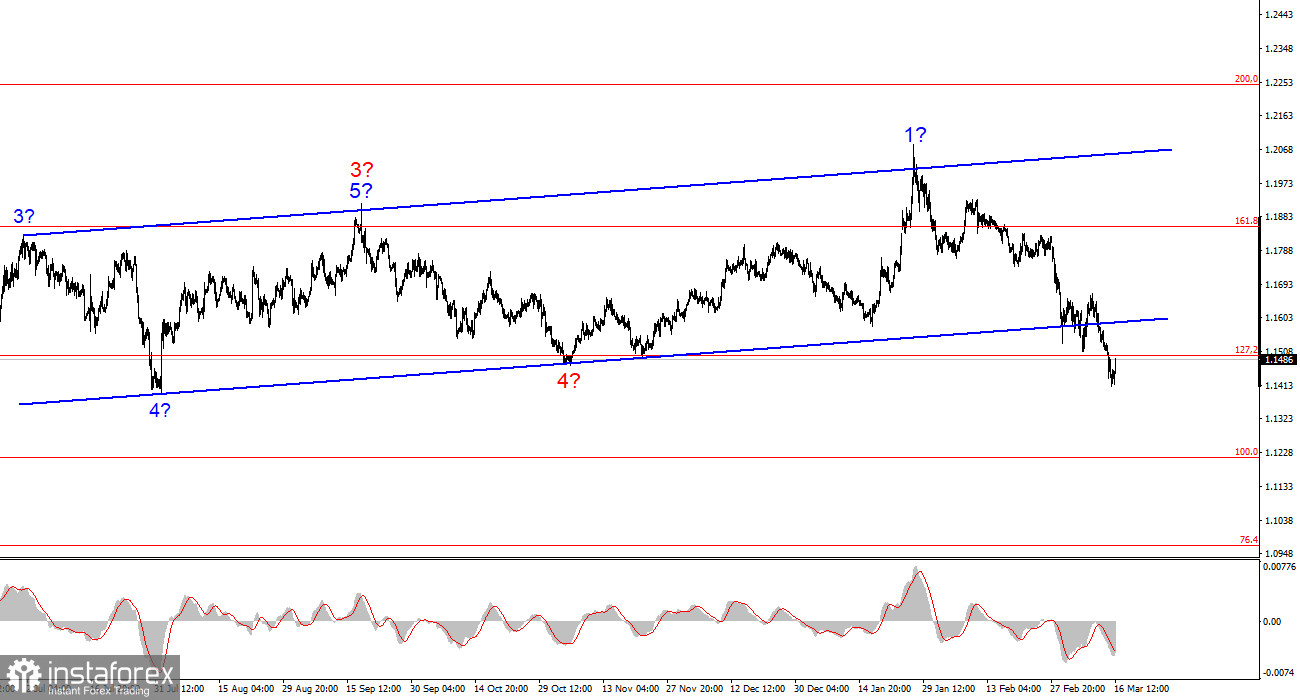
Based on the analysis of EUR/USD, I conclude that the pair remains within the upward trend segment (the lower chart), but in the short term it has begun forming a downward trend segment. Since the five-wave impulse structure has been completed, over the next one or two weeks my readers may expect price growth with targets located near the levels of 1.1568 and 1.1666, which correspond to the 23.6% and 38.2% Fibonacci retracement levels. Further movements of the pair will depend entirely on developments in the Middle East.
On the lower timeframe, the entire upward trend segment is visible. The wave structure is not entirely standard, as corrective waves vary in size. For example, the higher-degree wave 2 is smaller than the internal wave 2 within wave 3. However, this can occur. Let me remind you that it is best to identify clear structures on charts rather than strictly attaching importance to every wave. In the near future, the trend may reverse.
Key principles of my analysis:
- Wave structures should be simple and clear. Complex structures are difficult to trade and often change.
- If there is no confidence in what is happening in the market, it is better not to enter it.
- There can never be complete certainty about the direction of movement. Do not forget about protective Stop Loss orders.
- Wave analysis can be combined with other types of analysis and trading strategies.